I can tell which foot you led with on the stairs today

The stairs out of the 50th Street station are a strength test that nobody designed as one.
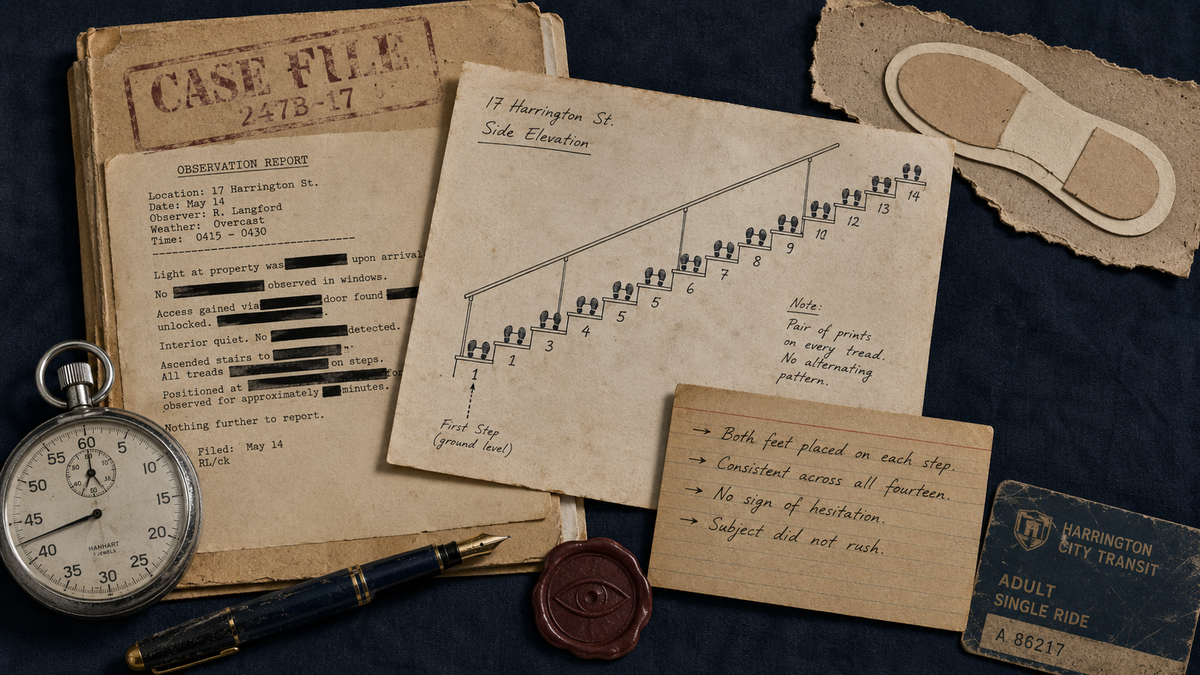
Fourteen steps. Steel nosing worn smooth down the middle of each tread. A handrail on the right going up, painted so many times that the paint has become the shape of the rail.
I have counted those steps more often than a well-adjusted person would.
Wednesday, 4:12 PM. The C had just emptied. Thirty-odd people moved at the stairs at once, which is the useful part. A crowd sorts itself. Watch any crowd take a flight of stairs and it separates into strategies inside four steps.
She was third onto the flight. Grey wool coat. Canvas tote on the right shoulder. Folded umbrella in the left hand. Early seventies, at a guess, and I am usually within five years.
She put her right hand on the rail before her foot touched the first step.
Then she went up. Right foot to step one. Left foot up beside it. Right foot to step two. Left foot up beside it.
Fourteen steps. Fourteen times. Both feet on every tread.
She never alternated once.
The Second Foot
Observation only · No contact · No identification · File remains open
Here is the thing about stairs. Almost everyone climbs them the same way for about sixty years, and then some people quietly stop.
The normal pattern is alternating. Left, right, left, right, one foot per step. You do it without thinking. You do it while carrying groceries and holding a conversation.
The other pattern has a name in physical therapy. Step-to. You lead with one foot, plant it, then bring the second foot up onto the same step. Both feet land. Then you do it again.
It is not slow, necessarily. Hers wasn't. Forty-one seconds for fourteen steps is unhurried, not laboured. She was not out of breath at the top. She did not stop halfway. She did not look distressed at any point.
What she did was pause. About two seconds at the base of the flight, hand already on the rail, before the first step. Not hesitation. Preparation. She was setting up.
And she led with the right foot every single time. Not alternating leads, not switching halfway. The same leg did all fourteen lifts. The other leg came along.
That is the detail that matters. Alternating means each leg lifts your entire body weight, once per step, on its own. Step-to means one leg does the lifting and the other one arrives.
If you cannot do the first thing, the body finds the second thing. It does not announce the change. It does not ask permission. It just quietly stops alternating, and it usually starts on stairs, because stairs cost more than walking does.
"She did not climb fourteen steps. She climbed the first step fourteen times."
Frame 1 — Two-second pause at the base. Right hand finds the rail before the first tread, not during the third. That is a plan, not a save.
Frame 2 — Right foot lifts to tread one. Body follows. Left foot arrives beside it and takes the load. Both feet flat before the next lift.
Frame 3 — The lead foot never changes. Fourteen treads, one leg doing all fourteen lifts, the other leg along as a passenger.
Frame 4 — At the top: no pause, no puff, no hand to the chest. Her lungs were fine. Her lungs were never the question.
Log 4:12 PM · Ascent 41 sec · Observation distance approx. 4 m
Stairs are expensive. Level walking is a fall you keep catching. Stairs are a lift.
On a flat pavement your body moves forward and gravity mostly stays out of it. On a step you have to raise your whole weight, several inches, on one leg, and then do it again. The big muscle on the front of the thigh does most of that work.
That muscle does not fail all at once. It loses speed before it loses size. The fibres that fire quickly go first, and those are exactly the ones a stair asks for.
There is a measurement that shows how close to the edge older legs run on stairs. In a 2019 study in Frontiers in Physiology, researchers measured how much force older adults' knees produced going down a staircase, then compared it to the maximum those same knees could produce on a testing machine. Coming down, the knee demand reached about 103 percent of measured maximum. Their legs were working at or past their own ceiling to walk down a flight of stairs.
Going up is cheaper than going down, but not by much.
And how a person moves turns out to carry information. In 2011, researchers pooled the individual records of 34,485 adults aged 65 and over from nine separate studies and followed them for six to twenty-one years. Every 0.1 metres per second of walking speed was associated with about a 12 percent lower risk of dying during follow-up. At age 75, predicted ten-year survival for women ranged from 35 percent at the slowest walking speeds to 91 percent at the fastest.
That is a population number. It is not a verdict on any one person, including the woman on the stairs.
Here is the everyday version. In the United States, about one in four adults aged 65 and older reports falling in a given year — roughly 14 million people. Around 37 percent of those who fall report an injury that needed treatment or kept them off their feet for a day or more.
Five points · No jargon · Read it once
- A stair is a lift, not a walk. On flat ground you fall forward and catch yourself. On a step you raise your entire body weight several inches using one leg. That is a much bigger job.
- One muscle does most of it. The big muscle on the front of your thigh straightens your knee and pushes you up. It is the single most expensive part of climbing a stair.
- Speed fades before size does. Muscles have slow fibres and fast fibres. The fast ones shrink first with age. A stair is a fast movement, so a stair notices before a chair does.
- Going down is harder than going up. Descending, the thigh muscle works as a brake, lengthening under load. In one 2019 measurement study, older adults' knees hit about 103 percent of their own tested maximum on the way down.
- When one leg can't, two legs will. If a single-leg lift is near the ceiling, the body switches to a cheaper method: land the lead foot, bring the other foot up beside it, share the load, repeat. Nobody decides to do this. It just starts.
Now the part where I argue against myself.
One flight of stairs is not a diagnosis. She was carrying a loaded tote on one shoulder and an umbrella in the other hand. She was in a rush crowd with people directly behind her. Her boots had stiff soles. Any one of those changes how a person takes a staircase, at any age. Load, footwear, and traffic all push people toward the safer pattern.
Strength may matter more than balance, and the balance story is weaker than it sounds. A 2021 study in the International Journal of Environmental Research and Public Health tested 44 patients waiting for knee replacement surgery. It timed them up and down a short flight of stairs. Thigh strength was clearly associated with stair time. Standing balance, measured while still, showed no significant association at all. So the neat line "stairs test your balance" is not supported there. Also: 44 people with severe knee arthritis is a small, specific group, and I am not going to pretend otherwise.
The braking number is from a small biomechanics study, not a cohort. The 103 percent figure comes from a laboratory group, not thousands of people followed for years. It shows a mechanism. It does not predict anything about an individual.
And the biggest problem for my own argument: the best trial we have of fixing this came back null. In the STRIDE trial, published in the New England Journal of Medicine in 2020, researchers enrolled 5,451 community-living adults aged 70 and over across 86 primary care practices. Specially trained nurses assessed each person's fall risks and built individual plans. Follow-up ran up to 44 months.
Over 3.5 years, serious fall injuries occurred in 15 percent of the intervention group and 19 percent of the usual-care group. That difference was not statistically significant. Self-reported fall injuries dropped about 10 percent, which was significant. Hospitalisations and deaths were the same in both groups.
That is a real result and it deserves saying plainly. A careful, well-funded, nurse-delivered programme did not clearly prevent serious fall injuries.
Nobody was asleep at the wheel there. Fall risk sits across a dozen specialties at once — eyes, drugs, heart rhythm, muscle, home layout — and no single clinic owns all of it. That is a structural gap, not a failure of anyone's attention.
What did work is narrower and more boring. A 2019 Cochrane review pooled 108 randomised trials with 23,407 community-living participants across 25 countries. Average age 76. Seventy-seven percent women. Exercise cut the rate of falls by 23 percent, rated high-certainty evidence. The exercise that carried the effect was balance and functional work, often with resistance training added. Not general activity. Specific practice at the thing itself.
Same stair · Same seven minutes · Same file
Log closed 4:19 PM · No contact · No identification
Let me put the numbers in the form that actually means something.
The 23 percent figure from the Cochrane review sounds enormous. In absolute terms it works out like this: in the control groups, about 850 falls occurred per 1,000 people over a year. Exercise brought that down by about 195 falls. Fewer people fell too — roughly 72 fewer fallers per 1,000 in a year.
Real. Worth having. Not a force field.
And the frightening end of this needs its own honest number. In 2023, the death rate from unintentional falls among American women aged 65 to 74 was about 14 per 100,000 per year. That is roughly one in seven thousand. The rate climbs steeply with age, and it is much higher after 85. But nobody in the 65-to-74 band should read this and lie awake. This is not a countdown.
The reason the second foot is worth noticing has nothing to do with mortality tables. It is that a staircase is a measurement you already take, several times a day, for free, and almost nobody reads the result.
Walking speed and leg power are not causes. They are readouts. Slowing down does not shorten your life; the things that slow you down are the things worth finding, and most of them are fixable or at least manageable. Arthritic knees. A drug combination that makes you unsteady. A hip that has quietly stopped working properly. Simple loss of strength from a few years of not lifting anything.
None of that announces itself. It arrives as a small change in how you take stairs, and the change feels so sensible in the moment that you never file it as information.
The man at the coffee bar last week had built a workaround so smooth that nobody at his table had noticed it, including him. Same thing here. The body is very good at solving a problem quietly and never telling you it solved one.
I profile. I do not prescribe. What follows is what I would want on a list before I walked into a doctor's office.
I profile · I do not prescribe · Every decision here routes to your own clinician
She reached the top of the flight and turned right toward Eighth Avenue without pausing. Coat, tote, umbrella, gone into the crowd in about four seconds. Nobody on that staircase saw anything. There was nothing to see. A woman took some stairs.
I went back down and came up again, because I wanted to know what fourteen treads actually feel like when you are counting them. Alternating, it is nothing. It is furniture. You arrive at the top with no memory of the climb.
That is the trouble with the good version of a thing. It leaves no trace. You only find out what a staircase costs on the day it starts costing something, and by then the body has usually already redesigned the route without telling you.
I have spent a professional lifetime being paid to notice how people move their legs, which sounds considerably worse out loud than it did in the contract. It has taught me one useful habit: the change is always cheaper to catch than the consequence.
Fourteen steps. Both feet on every one. No distress, no drama, no complaint.
File remains open.
— J.