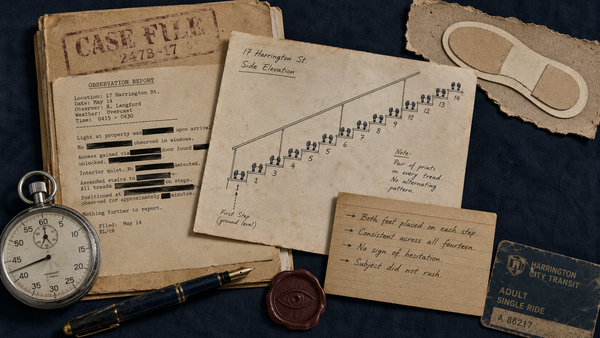
She lost 41 pounds. Her arms stood her up.

There are four chairs beside the blood pressure machine at the back of every chain pharmacy in America, and they are the most underrated surveillance position in the country.
Nobody performs in those chairs. The waiting room of a restaurant, the gate at an airport, the counter at a lunch spot — people are being seen in all of those places, and being seen changes the body. But the pharmacy pickup chairs sit behind the endcap of the vitamin aisle, under bad light, next to a cardboard display for reading glasses. People sit down there the way they sit down at home.
10:52 on a Thursday. I was two aisles over pretending to consider magnesium.
She was somewhere in her mid-fifties. Good coat, good haircut, the specific composure of a woman who has recently gotten a compliment she didn't have to fish for. She was smaller than she had been — I could tell that from the coat alone, which had been bought for a wider frame and was now doing that thing where the shoulder seam sits an inch out past the shoulder. Her watch had been taken in. You could see the old crease in the leather, two holes over.
By every metric the culture uses, this woman was a success story.
That's not the tell.
The tell was how she got out of the chair.
She had done the hard thing. The coat proved it, the watch proved it, the way she held her chin proved it. Nobody in that pharmacy would have looked at her and seen a problem.
I watched her for nine minutes and did not see a problem either.
I saw it in the last four seconds.
I want to be exact about something before we go further, because this is the part every publication on earth is currently getting wrong in one direction or the other.
The drug is not the villain of this file. I'm not going to spend nine hundred words telling you that a medication which reliably produces double-digit weight loss in people who have spent thirty years failing to achieve it is some kind of moral shortcut. That argument is beneath this newsletter and beneath you.
I'm telling you something narrower and much more useful.
Weight is a number. Weight is not a tissue. And when the number comes down fast, it comes down out of two different accounts — and only one of them is optional.
Slow it down.
A healthy adult in her mid-fifties, rising from a standard chair with a seat height of roughly 46 centimetres, does the following: she shifts her weight forward over her feet, and she stands. Her hands stay where they were. Her arms are not part of the transaction. The entire movement is one continuous piece, front to back, and it takes about a second.
That is not what she did.
FRAME 01. Her name was called. There was a pause of roughly a second and a half before anything moved — not confusion, not distraction. Preparation.
FRAME 02. Both hands went to the armrests. Not to steady herself. To load.
FRAME 03. A small rocking motion. Forward, back, forward — building momentum, the way you rock a car out of snow. Two rocks, then the commit.
FRAME 04. She pushed through her arms. Her triceps did work her quadriceps should have done. The rise took closer to three seconds than one.
FRAME 05. Upright, she stopped. One hand stayed on the chair back. Two full seconds of stillness with her eyes open and unfocused before she took a step. Then the step, and it was short — a stride noticeably clipped for a woman of her height.
FRAME 06. Nine feet later she moved her small paper pharmacy bag from her right hand to her left.
Six frames. One conclusion.
She had not lost forty pounds of fat.
She had lost forty pounds of body — and a meaningful share of it was skeletal muscle.
BIOLOGY IN 60 SECONDS
What I watched at that pharmacy is the field signature of lean mass loss during rapid weight reduction — and specifically, the version of it that shows up in the GLP-1 era.
Here is the mechanism, plainly.
When you lose weight — by any method, including one that has never involved a pharmacy — you do not lose pure fat. You lose fat and fat-free mass, which includes skeletal muscle. That's not a drug effect. That's physiology, and it's been true of every diet in human history.
What's different now is the magnitude. The trials that put these drugs on the map produced weight losses that dieting almost never achieves, and the fat-free mass came along proportionally. In a 2024 review in Diabetes, Obesity and Metabolism by Neeland and colleagues, the STEP-1 semaglutide data worked out to roughly 6.9 kg of lean mass lost against 15.3 kg of total weight — about 45% of everything lost coming from lean tissue. In SURMOUNT-1, the tirzepatide trial, the same calculation came to about 26%.
That percentage, on its own, is not scandalous. It's broadly comparable to what diet-driven weight loss produces. The problem is arithmetic: a fraction of a much bigger number is a much bigger number. Someone who drops 22% of a 100 kg starting weight can shed six to eight kilograms of fat-free mass — an absolute quantity most dieters never approach, because most dieters never lose that much of anything.
The picture is genuinely not one-sided, and I'm not going to pretend it is. The DEXA substudy from STEP 1, reported in the Journal of the Endocrine Society in 2021, found that while total lean mass fell 9.7%, lean mass as a proportion of the body actually improved by three percentage points — because fat fell faster. And the SEMALEAN study reported something more encouraging still: lean mass dipped early and then stabilised, handgrip strength improved by 4.5 kg at twelve months, and the share of patients meeting criteria for sarcopenic obesity fell from 49% to 33%.
So: this can go well. It goes well when somebody is watching.
The reason it matters when nobody is watching is that muscle is not cosmetic tissue. Under the revised European consensus on sarcopenia (Cruz-Jentoft et al., Age and Ageing, 2019), low muscle strength — not size, strength — is the entry criterion for a diagnosable muscle disease, with thresholds of a handgrip below 27 kg in men and 16 kg in women, or more than 15 seconds to rise from a chair five times. And in the PURE study of 142,861 adults, published in The Lancet in 2015, every 5 kg of lost grip strength tracked with a 16% higher risk of death from any cause — making grip a stronger predictor of mortality in that dataset than systolic blood pressure.
Which is the whole file in one line: she improved the number her doctor congratulates her for, and may have quietly degraded the one that actually forecasts her seventies.
THREE THINGS YOU DIDN'T SEE
THE COAT THAT FITS WRONG IN THE WRONG PLACE
Fat loss changes a garment's circumference. Muscle loss changes its architecture. When the deltoid thins, the shoulder seam stops being held out and the whole coat begins to hang from the neck instead of the frame. Every subject I've profiled who lost mass fast has this. Every subject who lost it slowly, with resistance training underneath it, does not.
A smaller coat is a result.
A coat that hangs is a warning.
THE HAND SWITCH AT NINE FEET
She moved a bag weighing perhaps a pound and a half from one hand to the other after nine feet. Nobody does that consciously. Grip endurance is the first thing to go and the last thing anyone thinks to measure, because a weak hand doesn't hurt — it just quietly stops volunteering. Watch how long people carry things before they change hands. It's the cheapest strength test in the world and it works on strangers.
Dropping something is a symptom.
Rearranging things so you never have to hold them is a strategy.
THE TWO SECONDS AFTER STANDING
That pause with the hand on the chair back is not indecision. It's a blood pressure event — the same orthostatic beat we took apart in an earlier file, and one that runs harder in people carrying low muscle mass, since the leg musculature is part of how the body returns blood upward against gravity. Rapid weight loss also frequently comes with reduced fluid and salt intake, which sharpens the effect. Two seconds is a pause. Two seconds at the top of a staircase is a fall.
Standing up is not the risk.
The two seconds you spend deciding whether you can walk yet — that's the risk.
I want to be very direct about what I am not saying, because on this topic the internet is a hall of mirrors and I refuse to add a reflection.
I am not telling you to stop a medication. I am not telling you to lower a dose. I am not telling you these drugs are dangerous — the cardiovascular and metabolic outcome data is, at this point, genuinely remarkable, and there are people alive because of it.
I'm telling you that the prescription is half a plan.
The wellness industry has responded to this moment in the two ways it always responds: by selling outrage, and by selling powder. Neither one requires anyone to measure anything. What follows requires you to measure something.
FIELD PRESCRIPTION
I'm a profiler, not a physician. Nothing below is medical advice, and nothing below should be used to start, stop, or adjust any medication. Every decision about a prescription belongs to you and the clinician who wrote it. What I can give you is a way to see what's happening to your body while it changes.
01 — ESTABLISH A BASELINE YOU CAN ACTUALLY REPEAT.
Sit in a hard dining chair, arms folded across your chest, and stand up and sit down five times as fast as you safely can. Time it. Under the EWGSOP2 criteria, more than 15 seconds is the threshold that flags probable low muscle strength. Write the number down with the date. If you can, get a handgrip reading too — many clinics and gyms have a dynamometer, and the reference cutoffs are 27 kg for men, 16 kg for women. Do this before significant weight loss if you're at the start of it, and every three months after.
02 — PROTEIN IS THE VARIABLE NOBODY DEFENDS.
Appetite suppression is the mechanism these drugs are for, and protein is usually the first casualty — it's the most filling macronutrient, so it's the first one people stop finishing. Reviews of lean-mass preservation during GLP-1 therapy converge on intakes above 1.2 g/kg per day, spread evenly across meals rather than loaded into dinner. Broader clinical guidance for adults in active weight loss lands in the 1.2–1.6 g/kg range. The evidence base here is honest about its own limits — a 2025 review in the International Journal of Obesity notes there are still no prospective trials establishing the optimal amount during GLP-1 treatment specifically. Bring the number to your clinician or a dietitian rather than to a comment section.
03 — DISTRIBUTION BEATS TOTAL.
The common failure pattern is coffee for breakfast, a few bites of salad at lunch, and the day's entire protein load at dinner. In the Health ABC cohort, older adults in the highest quintile of protein intake lost roughly 40% less lean mass over three years than those in the lowest. If appetite is genuinely small, three modest protein anchors beat one large one.
04 — RESISTANCE TRAINING IS THE NON-NEGOTIABLE.
Two to three sessions a week, compound movements, progressive load. Not walking. Not yoga. Not "staying active." Loaded muscle is the only signal that tells the body which tissue to keep when it's deciding what to burn. Every major consensus statement on this topic now recommends structured resistance training alongside the medication, not instead of it — and if you've never trained, this is worth one paid hour with a professional to learn form before you do it alone.
05 — RE-TEST AT TWELVE WEEKS AND ESCALATE ON A NUMBER, NOT A FEELING.
Take the chair-stand test again. If your time has gotten worse while your weight has gone down, that is a specific, concrete finding to bring to your prescriber — one they can act on with dose pacing, a dietitian referral, or body composition testing. "I feel weaker" gets you reassurance. "My five-rise time went from 11 seconds to 16" gets you a plan.
No detox. No cleanse. No powder with a superhero on the tub. No opinion from me about whether you should be on the drug at all.
Just a chair, a stopwatch, and the willingness to know.
She got her bag, she thanked the pharmacist by name, and she walked out into a bright Thursday looking better than she had in ten years.
She was not lied to. Everything she was told about that medication was true.
She was just never told what to watch while it worked.
The number on the scale is a summary. The chair is the source document.
Find a hard chair tonight. Time yourself. Then you'll have something worth comparing to.
— J.