Stand up without using your hands

He has lost thirty-five pounds and everyone has told him he looks wonderful. Watch him stand up. The scale is measuring the wrong thing.
Third Avenue, a coffee shop with too many outlets and not enough chairs, 11:20 AM on a Thursday. I was there for forty minutes waiting on a call that never came, which is the most productive kind of morning I have.
Two tables over: a man, late fifties, navy quarter-zip, reading something on a tablet. He looked good. That is not a throwaway line — it is the observation. His collar stood away from his neck. His watch had migrated up his forearm. And his belt was cinched two full notches past the worn hole, the leather still stiff and unmarked where the buckle now sat.
That belt is a timestamp. Leather takes months to remember a new position. His hadn't. Whatever he'd lost, he'd lost it fast, and he'd lost a lot of it.
Then he stood up to leave, and the entire story changed.
He put down the tablet. He put down the coffee — both hands now free, which is itself a decision his body made without consulting him. Then he placed a palm on each armrest, leaned forward, rocked once, didn't make it, rocked again, and pushed himself up out of the chair with his arms.
A man in his fifties should be able to stand out of a café chair with his arms folded across his chest and no more thought than it takes to blink. He couldn't. Nobody in that room noticed. He didn't notice.
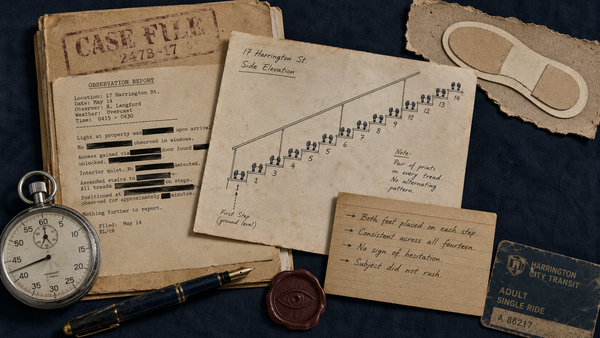
LOCATION: Coffee shop, Third Ave, 11:20
DURATION: 41 min observed
SIGNAL: Bilateral armrest push on rise; failed first attempt; forward torso rock
CORROB: Belt 2 notches past worn hole; collar slack
SCALE STATUS: Winning
BODY STATUS: LOSING
Here is the thing nobody puts on the before-and-after photo. When weight comes off, it does not come off as pure fat. It comes off as a mixture — fat, water, connective tissue, and muscle. The ratio in that mixture is not fixed. It is not fate. It is decided by two things you control, and most people control neither.
The numbers are older and less glamorous than the drugs currently reshaping American waistlines. A review of fifty-two weight-loss studies in middle-aged and older adults found that in groups losing weight by diet alone, 81% lost at least a sixth of their total weight as fat-free mass. In the groups that added exercise, that figure dropped to 39%.
Same weight loss. Radically different bodies at the end of it. One of them can stand up.
Try this before you read further. If you're sitting: fold your arms across your chest, hands on opposite shoulders, and stand up. Did you have to rock forward to generate momentum? Did a hand drift toward the armrest or the desk before you caught yourself? Now sit back down slowly, without dropping the last few inches. That part is harder. That part is the one that goes first.
Why the body liquidates the wrong asset
Your body is not sentimental about your legs. Under pressure it behaves like a company in a cash crisis — and muscle is the most expensive thing on the balance sheet.
The trigger. You eat far less than you burn, sharply, for months. The body doesn't get an itemized list of what you'd prefer to lose. It just knows the shortfall.
The reaction. Muscle costs energy simply to exist, and it doubles as a warehouse of amino acids. When protein arriving from food drops and nothing is asking that muscle to do hard work, the body reads it as a warehouse nobody visits. It starts selling the inventory.
The result. Fat leaves. So does the tissue that gets you off a chair, catches you when the curb is higher than you thought, and soaks up sugar after meals. The number on the scale falls beautifully. The thing the number was supposed to represent falls with it.
Now, I promised you precision, so here is the part the internet gets wrong in both directions.
The body-composition substudy from the landmark semaglutide trial scanned 140 people before and after 68 weeks. Total fat mass fell 19.3%. Visceral fat — the dangerous kind, packed around the organs — fell 27.4%. Lean body mass also fell, by 9.7%. But because fat fell faster, the proportion of the body that was lean actually rose by three percentage points. On that measure, these bodies improved.
A twelve-month study published this past year points the same direction. Grip strength went up by an average of 4.5 kg. The share of patients meeting criteria for sarcopenic obesity fell from 49% to 33%. Lean mass dipped early, then stabilized.
So no, I am not going to tell you these medications eat your muscles. That is a supplement company's talking point, and it is being sold to you at $49.99 a bottle right now. What I am telling you is narrower and more useful: rapid weight loss with no protein floor and no mechanical load is a specific, avoidable failure mode. It has nothing to do with which method got you into the deficit. Crash diet, bariatric surgery, a divorce, a prescription — the tissue does not care about your reason.
There is a second reason this matters, and it is the one people find out the hard way. In the extension of that same trial, participants who stopped the drug regained 11.6 of the 17.3 percentage points they had lost. Weight that returns does not consult your preferences either. The muscle you kept on the way down is the muscle you still have on the way back up.
The fix is not a supplement and it is not complicated. It is a floor and a load. Two instructions, both boring, both non-negotiable.
"A scale tells you how much of you there is. It has never once told you how much of you is load-bearing. Standing up out of a chair is the cheapest test on earth, and it does."
The chair test and the muscle floor
01 — Establish the baseline. Straight-backed dining chair against a wall. Arms folded across the chest. Stand fully, sit fully, for thirty seconds. Count complete stands. Write the number in your phone with today's date. This is the same test clinicians use to screen lower-body strength — you are simply administering it to yourself, for free, in your kitchen.
02 — Set the protein floor. While actively losing weight, the trial evidence clusters well above the standard dietary allowance. A practical floor is roughly 0.6 grams per pound of body weight per day — about 100 g for a 170-pound adult. Spread it across meals rather than stacking it at dinner. Breakfast is where most people lose the day.
03 — Apply the load. Two resistance sessions per week, legs included. Not walking — walking is excellent and it is not this. The muscle has to be asked for something it finds difficult. Bodyweight squats to a chair count. Meta-analyses in older adults with obesity find that adding resistance work to a calorie deficit protects muscle that dieting alone gives away.
04 — Change what you're tracking. Two numbers, monthly: the chair count and a tape measure at the navel. If the tape falls and the chair count holds or rises, the loss is going correctly. If the chair count is sliding, the loss is going wrong — regardless of what the scale is congratulating you for.
You are not trying to lose weight. You are trying to lose fat and keep the machinery. Those are two different projects, and they come with different instructions.
A note on limits, because you deserve the ceiling as well as the floor. The protein trial behind step two ran four weeks in forty young men under a severe deficit and heavy training. The direction is well replicated; the exact magnitudes are not transferable to a 58-year-old on a moderate deficit. I am giving you a floor, not a promise. And I am not your physician — if you are losing weight on a prescription, the chair number belongs in your next appointment, not just your notes app.
Three things you didn't see
1. He set the coffee down before he began to stand — a full three seconds before. The body pre-negotiates. It knew it would need both hands and it cleared them in advance. That is not clumsiness. That is a workaround so well-rehearsed it has become invisible to the person performing it.
2. The forward rock. When the quadriceps can't produce enough force from a dead stop, the body borrows momentum instead. Every rock is a small loan taken out against a strength account that is overdrawn.
3. On his way out, he held the door for a woman behind him — and shifted his full weight onto the door to do it. He is thirty-five pounds lighter than he was in the spring, and he is leaning on more things than he used to.
Your field note. Run the chair test today. Hit reply with one number: your count in thirty seconds, arms folded. Nothing else. I'm building a baseline across this list, and next week I'll tell you what the distribution looks like — including where I landed, which was not where I expected.
— J.
Your Health Profiler