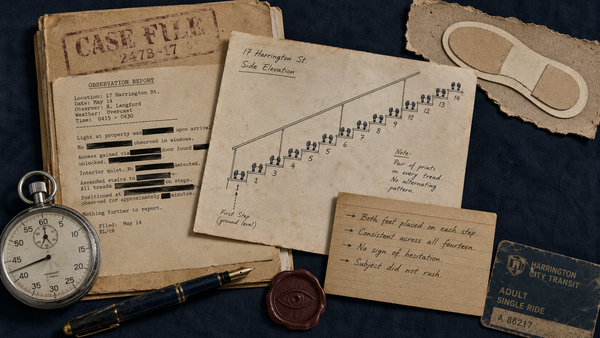
His wife will outlive him by twelve years. She stood up two seconds faster.

The check landed at 12:14. His wife was on her feet by 12:14 and two seconds. He was on his feet by 12:14 and eight. They were the same age.
That is a bigger difference than most of you will believe.
They had just finished a lovely Sunday brunch. Eggs, coffee, a shared pastry. He was in a tucked-in shirt and tortoiseshell glasses. She was in a navy blazer. They looked, to a casual observer, exactly like what they were — a couple in their mid-fifties in the middle of a good weekend. Nobody was watching them.
I was watching them.
Because when he saw the check land, something small and specific happened. He paused. Not for long — half a second, maybe less. He looked at the receipt. He looked at the door. He rocked his weight forward in his seat. He placed his palms flat on the table. And then he pushed.
Both hands. Full press into the table edge. A brief wobble at the top of the rise. A wide first step for balance. And then he was standing, adjusting his belt, saying something to the hostess he thought was casual.
His wife had already been standing for six seconds by then. She had not pushed. She had not paused. She had unfolded from the booth in a single smooth motion, taken her purse off the hook, and was already halfway to the door.
Subject:
The Way He Got Up
OPEN
Here's what I want you to understand before we go further.
He was not old. He was not sick. He was not visibly out of shape. He was, by every social metric, a fully functioning fifty-four-year-old man on a Sunday afternoon.
But he had just failed a test he didn't know he was taking. And it happens to be one of the strongest predictors of mortality that clinical medicine has ever validated in a real-world population.
The way you get up is the tell. And once you learn to see it, you cannot un-see it.
— The Tell —
“
He pushed himself up with both hands on the table and mistook a mortality-predictor for etiquette.
Field Observation · 8 Seconds · 3 Signals
Now the science. I'll keep it clean.
The transition from sitting to standing is one of the most quietly informative movements the human body performs. It requires — in the space of a single second — coordinated force from the quadriceps, gluteus maximus, gluteus medius, hamstrings, and the entire posterior chain, with balance managed on the fly by the vestibular system and the ankle stabilizers, and the whole sequence choreographed by a nervous system that has to decide, in real time, how much horsepower to allocate. There is nowhere to hide in that movement. When any part of the chain is degraded, the body cheats — by recruiting the arms, by pausing to gather momentum, by widening the stance on the way up.
The clinical literature has quietly known this for decades.
The sit-to-stand transition, and its more demanding cousin the floor rise, are now among the most validated non-aerobic predictors of mortality we have. The original Brito study followed 2,002 adults aged 51 to 80 who performed a simple test — sit down on the floor, then stand back up, using as little support as possible. Each hand or knee used to lower themselves or rise cost them a point out of a possible ten. Six years later, those in the lowest scoring group had roughly a five- to six-fold higher risk of all-cause mortality than those who scored a perfect ten. Adjusted for age, sex, BMI, and known clinical variables.
That finding was so strong that it has now been replicated in a much larger cohort. A prospective study published in the European Journal of Preventive Cardiology in 2025 followed 4,282 adults aged 46 to 75 for a median of 12.3 years. Lowest scorers had a 3.84-fold higher risk of natural mortality and a 6.05-fold higher risk of cardiovascular mortality compared to those who scored a perfect ten. The relationship was continuous — every step down the scoring ladder was another step up the mortality risk.
Grip strength tells the same story from a different angle. The Lancet published the PURE study in 2015, tracking 139,691 adults across 17 countries over roughly four years. Every 5-kilogram drop in grip strength was associated with a 16% higher risk of all-cause mortality, a 17% higher risk of cardiovascular mortality, and a 7% higher risk of myocardial infarction. Grip strength predicted death from any cause more accurately than systolic blood pressure did.
Both findings point to the same underlying variable, and it is worth being precise about what that variable is.
It is not muscle mass. Mass is a lagging indicator. Two people can have the same amount of leg muscle and vastly different amounts of usable output.
It is muscle power — the product of force and velocity. And muscle power declines earlier and more precipitously with age than muscle strength does. By your mid-fifties, you have measurably less of it than you did at forty, and the gap between the two decades is meaningful. Poor lower-body power carries roughly a threefold greater risk of mobility impairment than poor strength alone.
What this means, in the plainest language available: the ability to generate force quickly — the property that lets you stand up from a booth in one clean motion, catch yourself when you trip on a curb, get out of a low chair without pushing off with your arms, and, ultimately, produce the cardiac output needed for an unstressed heart — is the property that fades first. And its fading is the single most measurable predictor of when the body will start to fail you in ways that matter.
The man in the booth wasn't dying. He was not even in obvious decline. But he had lost more lower-extremity power than he knew, and every time he stood up from a low seat, he was borrowing from his upper body to compensate. His nervous system had built the compensation so smoothly he no longer noticed the borrowing.
The honest headline is smaller than the wellness industry pretends and bigger than you'd like. Not a diagnosis. Not a countdown. A signal — quiet, specific, quantifiable — that his body's fastest-declining system has already started declining, and that the window in which it is easiest to reverse is closing.
That is what those eight seconds were saying. To me. Not to him.
Surveillance Log · Micro-Signals
Three things you didn’t see.
Signal 01 · The Recruit-Check
A half-second pause before he rose. Weight rocking forward. Palms coming to rest on the table.
→Read: his central nervous system was calculating whether the legs alone had enough horsepower for the job. They didn’t. The pause was the moment his brain reallocated the movement to include the arms. Nobody who has been rising from booths their whole life notices this pause. His wife didn’t take it.
Signal 02 · The Two-Hand Push
Both palms driving flat into the table edge as he lifted. Elbows locking momentarily.
→Read: the upper body was subsidizing the lower body. Standard biomechanical compensation for lower-extremity power deficit. He didn’t rise from the legs — he pushed from the arms and let the legs catch up. Twenty years ago he stood up out of that booth without touching the table. He does not remember when the touching started.
Signal 03 · The Handoff Wobble
A brief lateral catch at roughly 60% extension, corrected by a widened first step.
→Read: 60% extension is the exact point where the quadriceps hand off to the glutes. His glutes didn’t take the handoff cleanly — the core caught the wobble, and the widened step let him bank on a broader base. This is the earliest visible marker of glute medius weakness, which is also the muscle that keeps you upright when you trip on a subway grate.
Now look at yourself.
You have done what he did. Probably more recently than you'd like to admit. The couch that used to be nothing has started needing a push from the armrest. The floor, once a fine place to play with a child or grandchild, now requires a plan for how to get back up. The low restaurant booth, the sports car, the airplane seat — you have a hierarchy in your head of chairs you'd rather not sit in, and you built it without ever writing it down.
You don't need me to tell you how you're doing. You already know. But since you're here, let me give you two tests you can run right now, at the desk you're reading this from, and get a real number.
Test one — the chair rise. Sit in a normal dining chair, no arms. Fold your arms across your chest so you cannot cheat. Stand up and sit back down five times, as fast as you can do it cleanly, without hands. Time yourself. Under twelve seconds is normal for a healthy adult over fifty. Twelve to fifteen is a yellow flag. Over fifteen is a red one — that is the range where physical therapists start ordering follow-up assessments.
Test two — the floor rise. If test one felt easy, escalate. Sit down on the floor and stand back up. Count every point of support you use: each hand on the floor is one point, each knee is one point, each elbow is one point. Start at ten, subtract one for each. A perfect ten means you sat down and rose without touching anything. Under eight is where the mortality curve in the SRT literature starts bending in ways you don't want it to bend.
Do them now. Or the next time you get up from your chair. It takes forty seconds.
Then run the honest audit.
Question one. When was the last time you got out of a low seat without touching anything with your hands? Not last week — the last time you actually noticed you didn't touch anything?
Question two. When was the last time you sat down on the floor voluntarily? Cross-legged, or knees to one side, or any way at all — and how did you feel about the getting-up part before you did it?
The gap between the answer you give and the answer you'd like to be giving is where your window is.
You are not old. You are not sick. You are running the same quiet discount the man in the booth was running — a lower-body power output that is a fraction lower than it was five years ago, a nervous system that has quietly rerouted the standing motion through your arms and your table edges and your armrests, a set of glutes that has been off duty since the last time you carried furniture up a flight of stairs — and you have been running it long enough that it feels like your baseline.
It is not your baseline. It is a fixable leak.
Field Prescription · Vance / Health Profiler
The Get-Up Protocol
Indication
For anyone who has quietly started using the table edge, the armrest, or the doorframe more often than they used to.
The daily chair rise · 10 reps
Every morning, before breakfast. A normal dining chair, arms folded across your chest. Stand and sit ten times, in a controlled rhythm, no hands. This is the single most direct way to reload the quad-glute chain that has been quietly disengaging on you for the last decade.
The weekly floor rise · 3 reps
Once a week — Sunday morning is fine — sit down on the floor and stand back up three times. Score yourself honestly. The goal is not to be a perfect ten. The goal is that your score this month is not worse than your score last month.
The single-leg stand · 30 sec × 2
While brushing your teeth, morning and night, stand on one leg for thirty seconds. Switch legs on the second brushing. This restores the ankle-hip stabilizer chain that catches you when you trip — the same chain the man in the booth couldn’t fully recruit on his handoff wobble.
The weighted carry · once a week
Once a week, walk with something heavy in each hand for five minutes. Two grocery bags. A pair of dumbbells. A suitcase in each hand for a hallway loop. Farmer’s carries are the closest thing free adult life has to a longevity intervention, because they train grip, core, and posterior chain at once.
Julian Vance · Rx · File 027
The man in the booth is not going to run this protocol. He is not going to see this post. He is going to keep pushing off from tables and armrests for another decade, and he is going to keep telling himself that he's fine, and by every measure he uses to check on himself, he will be.
But you are here. And you just timed your chair rise, or you are about to.
The way you get up is the tell. You are the one holding the stopwatch.
— J.