I can tell which shoulder carried your bag for ten years.

She's at a corner booth in a Midtown bistro, alone, working through a Caesar salad with the same hand that just dropped a leather tote the size of a Labrador onto the banquette beside her. I notice her because of what she does next — she rolls her left shoulder once, then again, the way you crack a vertebra back into a slot it forgot. Her right shoulder doesn't move. It can't. It's already two centimeters higher than the left, frozen in the silent uniform of someone who has carried a heavy bag on the same side every single day for most of a decade.
She doesn't see it. The mirror behind the bar shows her exactly what I'm seeing — a faint diagonal line running from her collarbone toward her opposite hip, the kind of tilt you'd flag with an architect's level — but her eyes are on her phone. The bag stays packed. The shoulder stays locked. She thinks she's relaxing. Her right trapezius hasn't relaxed since the Obama administration.
|
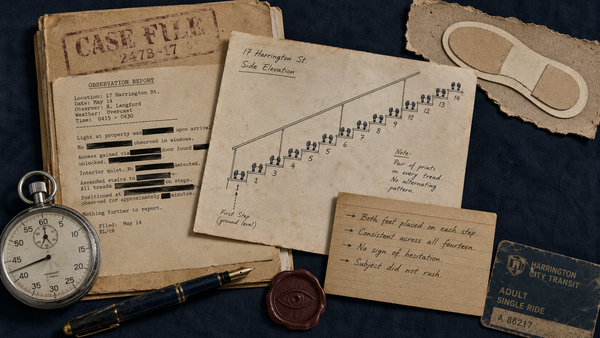
CASE FILE | ||||||||||||||
|
She isn't unusual. She is, in fact, the most ordinary person in the room. The man two tables over has the same tilt mirrored on the opposite side — laptop bag, right shoulder, ten years of conference rooms. The hostess carries her tablet braced against one hip. Every adult in this restaurant is wearing the same diagonal, in different uniforms. None of them know it.
Now do the thing she won't. Without adjusting anything — don't square up, don't fix it — glance down at the line your own shoulders are drawing right now. Which one sits higher? Which side has carried the laptop bag, the diaper bag, the tote, the briefcase, the wallet folded into the back pocket of your jeans for the last five years? If you cannot answer in two seconds, that hesitation is the answer. Your body has stopped flagging the imbalance because the imbalance has become baseline.
Here is what the bag actually did to you.
The shoulder doesn't lift on its own. It is being pulled — chronically, mechanically — by an upper trapezius and a levator scapulae that have been recruited as load-bearing tissue for years. The body, a master of efficiency, decides to keep them short. It shortens the muscle fibers. It thickens the fascia. It rewrites your resting posture so that "shoulders down and back" no longer feels neutral; it feels like effort. You aren't carrying tension anymore. You have been remodeled around it.
|
// BIOLOGY IN 60 SECONDS How a leather tote rewires your nervous system CASCADE PATHWAY — MUSCLE → SKELETON → LUNG → VAGUS | ||||||||||
|
That remodeling has a cost that lives well below the collarbone. A shortened trapezius rotates the rib cage. A rotated rib cage tilts the diaphragm. A tilted diaphragm cannot descend symmetrically on the inhale, which means one of your lungs receives roughly seventy to eighty percent of the breath you think you're taking and the other gets the leftovers. You are not shallow-breathing because you're anxious. You are shallow-breathing because there is no longer architectural room inside your torso for a full breath.
And here is the part nobody warns you about: a partially restricted diaphragm cannot stimulate the vagus nerve at the rate required to bring your sympathetic nervous system down between meals, between meetings, between Mondays. The bag is not just heavy. The bag is quietly recalibrating your stress baseline by reshaping the box your lungs live in.
|
// SURVEILLANCE LOG Three things you didn't see SUBJECT: SELF // OBSERVED FROM THE OUTSIDE IN | ||||||
|
The fix is not yoga. The fix is not a massage. Those treat the symptom of a load you keep re-applying. The fix is removing the load asymmetrically, the same way you applied it asymmetrically — one walk, one switch, one rib cage at a time.
|
℞ // FIELD PRESCRIPTION — ICSTU-009 The Cross-Body Balance Walk
| |||
| |||
|
Field Note: Hit reply with the side your dominant bag has lived on for the last five years. Left, right, or "I switch." The "I switch" replies are the rarest answers in my inbox. I read every one.
— Julian Vance (J.), Your Health Profiler
| FILE — CLOSED |