I Watched You Stand Up. I Know What You're On.

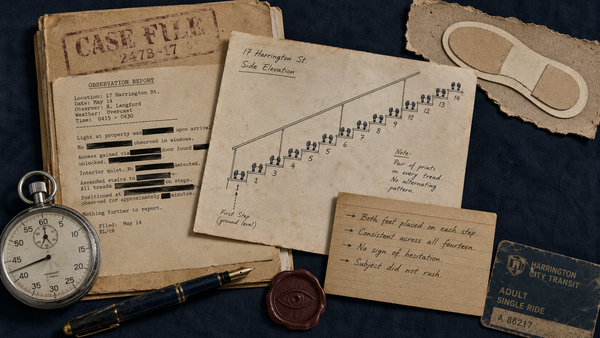
CASE FILE
Location: Independent coffee shop, corner booth
Time: 09:47
Subject: Female, early 50s. Dark blazer. Handbag that costs more than my first car.
Duration of observation: 43 minutes
She ordered a small oat latte and a chocolate croissant. In the first ten minutes she took two sips of the latte. She broke off a corner of the croissant, put it in her mouth, chewed twice, and set the rest down.
It stayed there. The latte went cold next to it.
That’s not the tell.
The tell was when she stood up.
THE TELL
At 10:29, her phone lit up. A message she wanted to respond to somewhere else. She checked her watch, gathered her things — coat over one arm, handbag looped over the shoulder, phone still in the left hand.
Then she stood.
Slow it down.
A healthy adult stands up from a café chair the way you throw a light switch — unconsciously, in a single fluid motion. The pattern is boring because it works. You shift your weight forward until your center of mass moves past your knees. Your quadriceps and gluteals fire in sequence. Your ankles dorsiflex. You rise. The whole event takes under a second and never enters your awareness. Your hands are free to hold coffee, a bag, a child, a phone.
That is not what she did.
She placed both palms flat on the wooden armrests of the café chair. She rocked forward once, transferred her weight through her hands, and pushed off — arms doing the work her quadriceps used to do without being asked.
Break it into frames:
Frame one. She sets her phone down on the table. Not into her pocket, not into the bag. On the table. She needs the hand.
Frame two. Both palms come down flat on the armrests. Not gripping — pressing. The wrists lock. This is the load-bearing position of a triceps extension, not a leg lift.
Frame three. Her torso pitches forward at the hip — further forward than it needs to be. This is compensation. She is moving her center of mass past her knees the long way, because her quadriceps cannot pull her upright from a normal seated angle.
Frame four. The push. The shoulders shrug up, the elbows extend, and for approximately half a second she is pressing herself out of the chair with her arms. The legs finish the motion. They do not start it.
Frame five. She is standing. She reaches back down for the phone. She never noticed what she did.
She’s in her early fifties. There is no cane. There is no visible injury. There is a six-hundred-dollar handbag on her shoulder and a wedding ring that hasn’t been resized in a while. Every person in that café who happened to glance up saw a well-dressed woman get up from a chair. Nobody saw anything.
But that motion — palms flat, forward pitch, arm push — is a specific biomechanical fingerprint. It has a name in geriatric medicine. It is called substitution strategy, and it is what the human body does when the quadriceps have quietly lost enough strength that the arms have to be recruited to make up the difference. You see it every day in nursing homes. You do not expect to see it at 10:29 on a Tuesday in a woman who has the resting heart rate of someone who runs.
Six weeks ago, I would bet money she stood up from that same chair without touching it.
She is not sick. She is on a drug.
BIOLOGY IN 60 SECONDS
The push-off is the field signature of sarcopenia — accelerated loss of skeletal muscle mass. In the wild, sarcopenia takes decades. On a GLP-1 receptor agonist (semaglutide sold as Ozempic and Wegovy, tirzepatide sold as Mounjaro and Zepbound), it can take months.
Here is what the registration trials actually reported, without the morning-show gloss:
- STEP 1 (Wilding et al., NEJM 2021): 68 weeks of semaglutide produced 14.9% average weight loss. Of that loss, roughly 39% was lean mass.
- SURMOUNT-1 (Jastreboff et al., NEJM 2022): 72 weeks of tirzepatide produced up to 20.9% weight loss. Roughly 26% was lean mass.
- A 2024 network meta-analysis of 22 RCTs and 2,258 participants: lean mass loss averaged ~25% of total weight lost across the GLP-1 class. A broader 2024 review in Diabetes, Obesity and Metabolism puts the range at 25%–40% depending on the agent and dose.
This is not a scandal. Rapid weight loss from any cause — bariatric surgery, illness, aggressive calorie restriction — pulls lean tissue along with fat. That is the physiology of catabolism. You cannot lose weight without a real-time energy deficit, and the body will not politely draw that deficit only from adipose stores.
What is different about GLP-1s is the mechanism upstream. The drug delays gastric emptying and blunts the appetite signal at the level of the hypothalamus. Removing appetite removes food. Removing food removes protein. Removing protein removes the raw material muscle uses to hold itself intact. And unlike a person recovering from surgery, the patient on a GLP-1 feels good — steady energy, no cravings, clothes looser every week. There is no pain signal. There is no warning light. Meanwhile the drug offers no biological incentive to lift anything heavier than a phone.
The result shows up in the chair.
The push-off tell is muscle mass loss localized to the quadriceps and gluteals — the two engines of standing up from a seated position. When they atrophy, the arms step in. The body finds the shortcut. The brain does not send you a memo. You simply, one day, start using the armrest.
THREE THINGS YOU DIDN'T SEE
1. Her plate.
Not the croissant she left behind — the way she looked at it. She was not restraining. She was uninterested. She had bought it out of a habit her body no longer shared. That is the pharmacological signature of GLP-1: satiety without desire. The “food noise” people describe silencing is not a metaphor — it is the constant hypothalamic chatter about food that most of us have been listening to since childhood, switched off. It is why the drug works. It is also why the muscle goes: you don’t eat, so you don’t get protein, so you don’t rebuild.
2. Her jawline.
Faint sag along the mandibular border. This is not aging. It is not “Ozempic face” as a cosmetic quirk to be filled with hyaluronic acid. It is the earliest visible surface of a whole-body protein deficit — subcutaneous fat depleting faster than collagen can restructure around it. It shows up at the jaw and hands first because the fat pads are thinnest there and the skin has the least architectural support. If the face is showing it, the deeper tissues have been showing it for weeks. You just could not see those.
3. Her walk out.
Shorter stride than the one she walked in with. I clocked both. Reduced stride length is one of the first biomechanical fingerprints of quadriceps and hip flexor weakness — a documented feature of sarcopenic gait. She is not limping. She is not slow. She has simply lost about an inch of push per step, and over a mile that is a hundred and twenty fewer steps’ worth of covered ground. She has been losing distance-per-step for weeks and has not noticed. She thinks she is walking. She is shuffling.
She lost weight. She also lost the muscle that carries her weight.
The scale said “success.” The chair said “we are not done here.”
FIELD PRESCRIPTION
The point of this file is not don’t take the drug. That is not my lane and I am not your prescriber. The point is: if you take the drug, do not let the drug take your muscle.
The SEMALEAN study (2024) followed 106 adults on max-dose semaglutide for 12 months. Lean mass dropped roughly 5% and stabilized by month 7. Handgrip strength actually improved by 4.5 kg on average. Sarcopenic obesity prevalence in the cohort fell from 49% to 33%. The people who preserved and rebuilt their muscle on the drug were not lucky. They loaded it.
Four-week protocol. No gym required. No supplements listed.
1. Sit-to-Stand baseline, twice weekly.
Regular kitchen chair. Arms crossed over your chest — no cheating. Count the number of full stands you complete in 30 seconds. Under 12 reps if you are 45–55 is your yellow flag. Under 8 is red. Retest every seven days. If the number drops on the drug, you have your answer before the mirror or the scale gives it to you.
2. Bodyweight squats — 3 sets of 8, three times a week.
Descend for a count of four. Full one-second pause at the bottom. Stand up under control. If your quads shake by rep five, that is not weakness — that is the exact recruitment deficit the café tell reveals. That trembling is the muscle you are keeping. Resistance training, even at bodyweight, is the single most consistently replicated intervention in the caloric-restriction lean-mass-preservation literature — a 2018 meta-analysis in Nutrients pooled six RCTs and found it prevented essentially all of the muscle loss otherwise caused by dieting alone in older adults.
3. Protein floor: 1.6 grams per kilogram of body weight per day.
This is the resistance-training-adjusted number replicated across multiple sarcopenia and lean-mass-preservation trials. Seventy kilograms means 112 grams of protein daily. On a drug that has switched off your hunger, you will not hit this by accident. You will hit it by engineering every meal to lead with protein before anything else touches the plate. Order the eggs first. Eat them first. The oat milk latte is not a meal.
4. Grip strength check, monthly.
Cheap hand dynamometer, roughly $20. Below 26 kg for women or 42 kg for men in midlife is an established sarcopenia marker independent of body weight. Grip correlates with total-body muscle quality better than almost any other single field test. Log it. Watch the trend, not the number.
No supplements. No brand names. No affiliate biology. The drug is doing its job. This is yours.
FILE STATUS: OPEN
The subject left the café at 10:31.
She did not look at the chair on the way out.
I did.
— J.