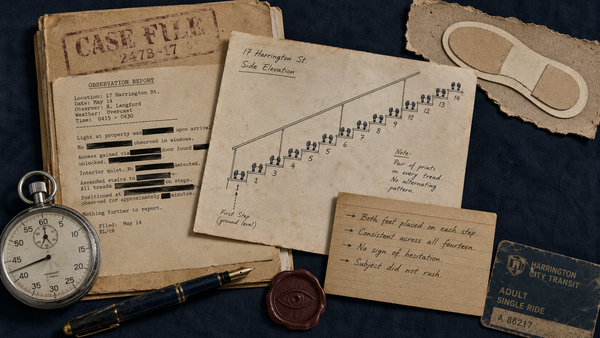
You thought it was hunger. Look at your lower lip.

He walked out to a standing ovation.
Thirty-seven minutes later, he walked off looking like a man who'd just been mildly poisoned. Nobody in the audience noticed. The moderator thanked him warmly. The panelist beside him clapped. The room did what rooms do at 10:47 on a Thursday morning in Midtown — it pretended everything was fine.
But I was in row four with a clear line of sight to his lower lip. And by minute nine, I had stopped listening to what he was saying and started counting how many times he bit it.
Twenty-four.
That was the number I had by the time he finished. Twenty-four small, unconscious teeth-to-lip contacts, each one lasting less than half a second, each one followed by a quick tongue-sweep to redistribute the moisture that wasn't there. He never touched the water glass on the podium. He didn't know he needed it. His body was telling him. His brain wasn't listening.
Subject:
The Dehydrated Lip-Bite
OPEN
Here's what I want you to understand before we go further.
He wasn't nervous. This wasn't stage fright. This was a man at the top of his industry, giving a talk he'd rehearsed a dozen times, in a room full of people who already agreed with him. His cortisol wasn't spiking. His heart rate was probably in the low seventies.
He was dehydrated. Mildly, subclinically — the way most of us are dehydrated every single day between 9 AM and lunch. Not the kind of dehydration that ends in an IV bag. The kind that ends in a decision you'll wonder about later. An offer accepted too fast. A name forgotten mid-handshake. A sentence that came out slightly clumsier than the one in your head.
The lip-bite is the tell. And once you learn to see it, you cannot un-see it.
— The Tell —
“
He took the podium, licked his lower lip for the ninth time, and mistook a plasma crash for stage nerves.
Field Observation · 37 Min · 24 Lip-Bites
Now the science. I'll keep it clean.
Your lip mucosa is one of the thinnest, most exposed tissues on your body. No sweat glands. No keratin layer. It cannot hold moisture. When your total body water drops by even one to two percent, your lips are the first surface to broadcast the loss — which is why they crack, chap, and start feeling papery long before you consciously register thirst.
That word "consciously" is doing a lot of work here.
Your hypothalamus registers plasma osmolality — the salt-to-water ratio in your blood — and fires the thirst signal well before you feel dry. If you are over forty-five, that signal is measurably weaker than it was when you were twenty-five. A foundational 1984 study in the New England Journal of Medicine showed that healthy older men, after twenty-four hours without water, reported markedly less thirst than younger men — despite higher plasma osmolality and higher vasopressin levels. Blunted thirst is one of the most consistent findings in aging physiology. You are not drinking when you should be. You are drinking when you finally notice, which is much later.
And in the gap between those two moments, cognition takes a hit.
The published data here is more careful than the wellness industry suggests, but it is real. Research from the University of Connecticut on men at roughly 1.6% body-mass dehydration showed measurable declines in visual vigilance and working memory, alongside elevated fatigue, tension, and anxiety. A companion study on young women at 1.36% dehydration found degraded mood, headache, lower concentration, and — critically — an increased perception of task difficulty. Meaning the same work felt harder to do. A 2018 meta-analysis pooling thirty-three studies confirmed that dehydration impairs attention, executive function, and motor coordination, with the effect growing meaningfully once body-mass loss crosses two percent.
The honest headline is smaller than the wellness industry pretends and bigger than you'd like. Not a ten-percent collapse of your IQ. A small-to-moderate hit to sustained attention, a slower and slightly less accurate response on complex tasks, and a step-up in how hard every mental task feels for the same amount of output. Not enough for a stranger to say you look off. Enough for you to hedge on the decision you should have closed on.
The speaker at the Hilton did not know he was operating at a discount. But everybody who watched him could feel it. That is what subclinical means. Below the threshold of self-detection. Fully visible to the trained eye.
Surveillance Log · Micro-Signals
Three things you didn’t see.
Signal 01 · Lip
Fine vertical creases deepening across his lower lip between minutes twelve and twenty-eight.
→Read: lip mucosa has no keratin barrier, so it broadcasts plasma loss before any other tissue can. Each new crease is a millimeter of blood volume gone. Stage lights push another 200 mL out through the skin while he stands there and calls it stage nerves.
Signal 02 · Tongue
A quick lateral sweep across the lower lip before every third or fourth sentence. Rhythmic. Predictable.
→Read: salivary glands are behind on production and the tongue is running manual moisture management on autopilot. The hypothalamus fired the thirst signal thirty minutes ago. His prefrontal cortex overrode it. The sweep is the compromise.
Signal 03 · Step-Down
The two-handed grip on the water glass the moment he left the podium.
→Read: fine motor coordination degrades measurably under even mild fluid loss. His brain rerouted the water grab through the older, bimanual motor pattern because the single-hand precision one couldn’t be trusted. He held the glass like it might slip. Then he still forgot to drink.
Now look at yourself.
You have done this. Probably today. Probably before a meeting that mattered, before a call you were told would be casual, before the moment you sat down to write the email that has been sitting in your drafts folder for two hours. You woke up, drank coffee, forgot about water, and walked into your morning already down a beat.
Run your tongue along your lower lip right now. Is it smooth, or is there a fine ridge of dry tissue near the center? Pinch the skin on the back of your hand and let go. Does it snap back immediately, or does it hesitate for half a second before flattening?
Those two tests take four seconds. If you are over forty-five, there is a real chance you fail at least one of them and register nothing wrong.
You are not sick. You are not in crisis. You are running the same quiet discount the speaker was running — slower attention, harder concentration, a lower ceiling on the version of yourself you're able to bring into the room — and you have been running it long enough that it feels like your baseline.
It is not your baseline. It is a fixable leak.
Field Prescription · Vance / Health Profiler
The Salt-Pinch Water Reset
Indication
For anyone about to walk into a high-stakes room with a dry mouth and no plan.
Pinch first, water second
A dry pinch of unrefined salt on the tongue. Let it dissolve. Then twelve ounces of plain water. Sodium is the ferry — without it, most of that water rides straight through the kidneys and never reaches the cells that actually need it.
Twenty minutes ahead
Do it twenty minutes before the moment that matters. That’s the window plasma volume needs to fully restore. Chug it as you walk on stage and you’re just sloshing — the cognitive lift hasn’t landed yet.
Skip the ice
Room-temperature or barely cool. Ice water constricts the stomach’s vessels and slows gastric emptying — the fluid sits there instead of moving into circulation. Warm enough to drink comfortably in one steady pull is the target.
The podium top-up
Keep a glass at hand and take a real sip between segments, not a stage-nervous lip-lick. Two ounces every ten minutes keeps the salivary glands online and shuts down the bite-tic your audience is already registering as uncertainty.
Julian Vance · Rx · File 017
One last thing before I let you go.
The salt-pinch reset is one of the few interventions I recommend that gives you a felt result inside the same hour. Not a health protocol you have to trust me on for six weeks. A biochemical adjustment you can run before your 2 PM call today and evaluate for yourself.
Try it once this week. Just once. Twenty minutes before the meeting or the pitch or the difficult conversation that already has you a little tight. Then tell me what you noticed.
I read every reply.
— J.