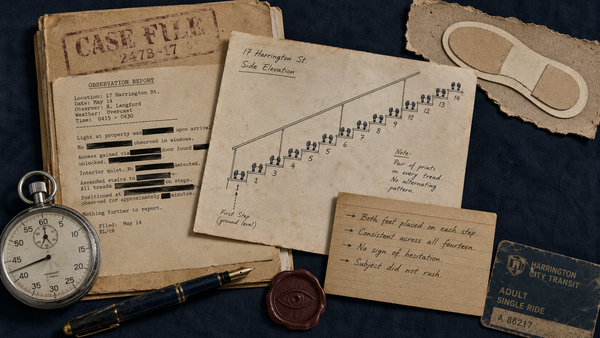
Your phone knows.
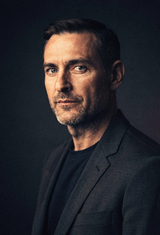
Today's subject is a 47-year-old male, seated at a rented desk in a fourth-floor Chelsea walk-up, backlit by a 27-inch monitor at 2:14 a.m. He is typing. He looks fine.
He is not fine. I know this because the subject is me, three years ago, and last Tuesday I found the iPhone he was using. I charged it. I unlocked it. I opened the Health app he never once opened while he owned it.
The phone had been running a case file on him the entire time.
Sleep average across the 47 nights leading up to the emergency room visit: 4 hours, 12 minutes. Bedtime standard deviation: 143 minutes. Which is a polite way of saying that in a two-month window, he went to bed at times ranging from 11:40 p.m. to 3:57 a.m. and got up whenever the alarm broke him. His phone knew. He didn't.
Subject:
The Man Who Slept Blind
REOPENED
For fifteen years, I profiled other people's blind spots. I sat in windowless conference rooms and told insurance adjusters exactly which claimants were lying and which were quietly dying. I read faces. I read gaits. I read the half-second pause between a man saying "I'm sleeping fine" and reaching for his water glass with a hand that had a tremor at 8:03 a.m.
I did not read myself.
The reason is boring. I believed what I told myself about sleep because I was the one saying it. "Six hours is my number." "I've always been a light sleeper." "Coffee doesn't affect me." A profiler who spends his career catching people using these exact rationalizations, using them on himself, and never noticing.
The phone noticed.
— The Tell —
“
He set the phone on the nightstand every night for forty-seven nights, called four hours ‘six’, and mistook chronic sleep irregularity for stamina.
Retrospective File · 47 Nights · 4h 12m Avg
Here is what has changed in the three years since. Sleep stopped being something I did and became something I measured. Not because I bought into wellness theater. Because I finally looked at the numbers a $300 device had been quietly generating on my nightstand, and the numbers made the case my body couldn't make loud enough to reach me.
For most of the last four decades, sleep sat at the bottom of the American health hierarchy — under diet, under exercise, under supplements, under whatever the podcast circuit was calling "biohacking" that quarter. You optimized what you ate. You optimized what you lifted. Sleep was the space between the things you optimized. It was the reset button. Not the metric.
That has changed. And it should have changed for me sooner.
I want to make one thing precise, because Julian-three-years-ago would have used the imprecision to talk himself out of it: consumer sleep trackers are not lab-grade. A polysomnography validation study will pull sixteen channels of data off your skull and score your sleep architecture to within a few percent of ground truth. A ring on your finger will not.
But that isn't the point, and it never was. Recent validation work published in Sensors found that against gold-standard polysomnography, modern consumer devices detect sleep versus wake with sensitivity at or above 95 percent. Sleep-stage estimation is fair to moderate — the Oura Ring Gen3, for example, showed 76–79 percent sensitivity across stages, which is not perfect but is close to the agreement rate between two human technicians scoring the same night.
What that means, in operational terms, is that your ring or your watch is very good at answering the three questions that matter most for the 45-plus adult trying not to end up where I ended up: When did I actually fall asleep? How long was I actually asleep? How consistent is my timing week over week?
Those three numbers are the ones that predict how long you live.
The single largest reframe in sleep research in the last five years is this: how regular your sleep is may matter more than how long it is.
Read that again. Consistency of bedtime beat total hours in a cohort of nearly 61,000 adults tracked for years with wrist-worn accelerometers. The people in the highest quintile of sleep regularity had up to a 57 percent lower risk of dying from cardiometabolic disease compared to the most irregular sleepers.
The version of me at that Chelsea desk was not, technically, a short sleeper. He was an irregular sleeper. Some nights, five hours. Some nights, three. One notorious Thursday, ninety minutes. The average was bad. The variance was worse.
Nobody at any of the doctors' offices I visited that year asked me about variance.
Surveillance Log · Retrospective
Three things he didn’t see.
Signal 01 · Screen-Gap
Screen-on activity ceased at 23:47 and resumed at 06:03. A six-hour dark window the subject called sleep.
→Read: a dark phone is not the same as an unconscious brain. Accelerometer data shows the man was moving in the bed for most of it, phone face-down at arm’s length. The story he told out loud was seven hours. The measurement was four hours, twelve minutes. He never opened the app that knew the difference.
Signal 02 · Resting HR
Overnight resting heart rate rose from 58 to 71 across the sixty nights before the emergency room.
→Read: a thirteen-beat climb at rest is not deconditioning. It is autonomic strain, and it is happening in the exact hours the subject called ‘recovering.’ The Health app plotted it as a diagonal running up the screen for two months. The diagonal did not care that no one was looking at it.
Signal 03 · Alcohol Correlation
Every bar tab timestamped after 22:00 aligned with a further drop in continuous sleep and an eight-beat rise in overnight heart rate.
→Read: the subject told friends alcohol ‘helped him sleep.’ The device said alcohol dropped his continuous window from 4h 12m to 3h 41m and pushed his overnight cardiovascular tone into a zone he would have flagged as a red flag on any other case file. The self-report was wrong by a margin that would have been actionable in any other line of work.
There is a specific pattern I see in men my age, when I ask them about sleep. It goes like this: they tell me their "usual" number — 6.5, 7, 5.5 — and they say it with certainty. Then I ask whether they've measured it. Almost none of them have. The number is not data. The number is identity.
If you take one thing from this dispatch, take this: your subjective sense of how you sleep is not a reliable witness. Mine wasn't. The phone was.
The next time someone asks you how you slept, resist the urge to answer with a feeling. Answer with a number, or answer with "I don't know yet." Both are honest. The feeling is not.
Field Prescription · Vance / Health Profiler
The 14-Night Baseline
Indication
For anyone who’s answered ‘how did you sleep?’ with a feeling for the last ten years without ever measuring the thing.
Instrument first, judge later
Wear a device — any of them — for fourteen consecutive nights. Do not read the app. Do not ‘try harder’ this week. You are collecting a baseline, not passing a test. Optimization before measurement is what got the last version of you here.
The three that matter
At day fourteen, look at three numbers only. Mean total sleep time. Bedtime standard deviation. Mean overnight resting heart rate. Everything else on the screen is decoration — sleep scores, readiness rings, stage percentages. These three are the levers.
Regularity, then duration
Lock a bedtime window of plus-or-minus thirty minutes for twenty-one nights before you touch anything else. The largest study we have — sixty thousand adults tracked with wrist accelerometers — showed regularity outperformed duration as a mortality predictor. Fix the variance first. The extra hour comes later.
Re-score weekly, in writing
One number per week, written down where you can see it. Not a feeling. Not ‘I felt rested.’ A number. If four consecutive weeks of a locked bedtime do not move that number, you have a signal, not a failure. See a sleep physician. Undiagnosed apnea is common past forty-five and gets missed by everyone including you.
Julian Vance · Rx · File 027
I don't know if the man in that photograph would have listened to me. I profile for a living. I know how hard it is to profile a subject who trusts his own testimony over the physical evidence in the room.
But the physical evidence was there. It was on his wrist. It was on his nightstand. It was on the phone that survived the emergency room visit that he did not, initially, look likely to survive.
If you're reading this, your phone is almost certainly building the same case file on you. Right now. Tonight. It costs nothing to open it.
Open it.
— J.